fastphylosig
Fast Phylogenetic Signal Statistics
Provides one-command and method-specific workflows for
phylogenetic signal in continuous, binary, and categorical traits. Compiled
tree-pruning algorithms implement Blomberg's K and Pagel's lambda without
constructing a dense phylogenetic covariance matrix in production.
Fritz and Purvis D retains separate random and Brownian null models, while
categorical Delta combines discrete ancestral-state likelihoods with MCMC
and permutation diagnostics. The package also provides reusable prepared
trees, explicit tree/data matching, trait-wise missing-value handling,
conservative tree diagnostics, bounded simulation memory, and structured
timing and Monte Carlo uncertainty metadata. Methods follow Blomberg,
Garland and Ives (2003)
fastphylosig
Package website | GitHub | Issues | Chinese guide
fastphylosig calculates phylogenetic signal for continuous, binary, and
categorical traits. Most analyses need one function: fast_signal(). The
method-specific functions remain available when you want to inspect and
control each step.
Speed on larger trees
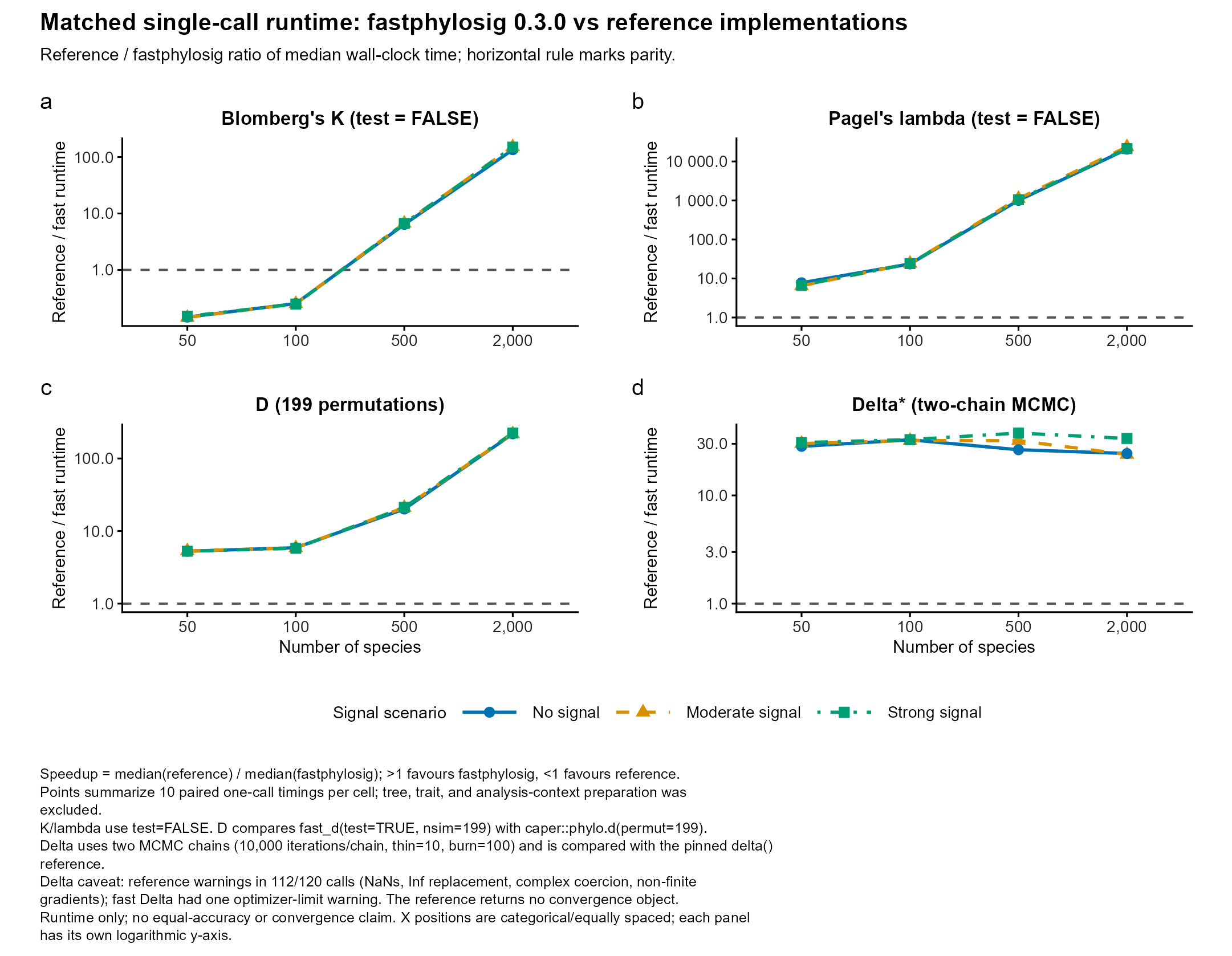
On 2,000-species trees, observed reference/fastphylosig median runtime ratios were 135–151 for K, 20,697–23,591 for lambda, and 218–224 for D across three simulated signal scenarios. Delta call-time ratios were 23.9–33.6, subject to the diagnostic caveat below. Each cell has 10 matched pairs; tree/data preparation is excluded. The dashed line is equal runtime; small-tree K is slower than phytools at 50 and 100 species, and those results remain visible.
References are phytools 2.5.2 (K/lambda), caper (D) and a pinned Borges Delta
implementation. K/lambda use test = FALSE; D includes 199 randomizations;
Delta uses two 10,000-iteration MCMC chains without permutation testing.
Delta caveat: 112/120 reference calls produced numerical warnings and
did not expose final convergence information; one fast call reached an
optimization iteration limit. Delta ratios describe observed returned-call
times, not demonstrated equal-accuracy or converged-fit speedups.
These Windows/R 4.6.1 timings are workload-specific, not universal guarantees.
See all data, settings and diagnostic details.
Install
The local 0.3.1 patch contains five correctness fixes; it has not been published. Install the supplied source archive with an existing C++ toolchain:
install.packages("fastphylosig_0.3.1.tar.gz", repos = NULL, type = "source")
library(fastphylosig)
For the previously published GitHub release:
install.packages("remotes")
remotes::install_github("yinwen-ecology/[email protected]")
library(fastphylosig)
Source installation requires a C++ toolchain. OpenMP is optional.
Start here: one command
Once you have a phylo tree and named trait data, choose a method and run:
set.seed(1)
tree <- ape::rtree(30)
trait <- stats::setNames(stats::rnorm(30), tree$tip.label)

fit <- fast_signal(
  tree, data = trait, method = "K", progress = FALSE
)
summary(fit)
That is enough for a standard analysis. fast_signal() checks the tree,
matches species, handles missing values trait by trait, and runs the selected
calculation.
Choose method from the question and trait type:
| Target | method |
Input | Returns |
|---|---|---|---|
| Blomberg's K | "K" |
continuous | K estimate; optional permutation test |
| Pagel's lambda | "lambda" |
continuous | lambda likelihood and LR test |
| Fritz--Purvis D | "D" |
binary | random and Brownian null comparisons |
| Delta | "Delta" |
categorical | Delta estimate, MCMC diagnostics, optional permutation test |
The method is always explicit; it is not guessed from trait values. Use
print(fit), summary(fit), as.data.frame(fit), or plot_signal(fit) to
inspect the result. Unknown or method-inapplicable arguments produce an error.
How the workflow runs
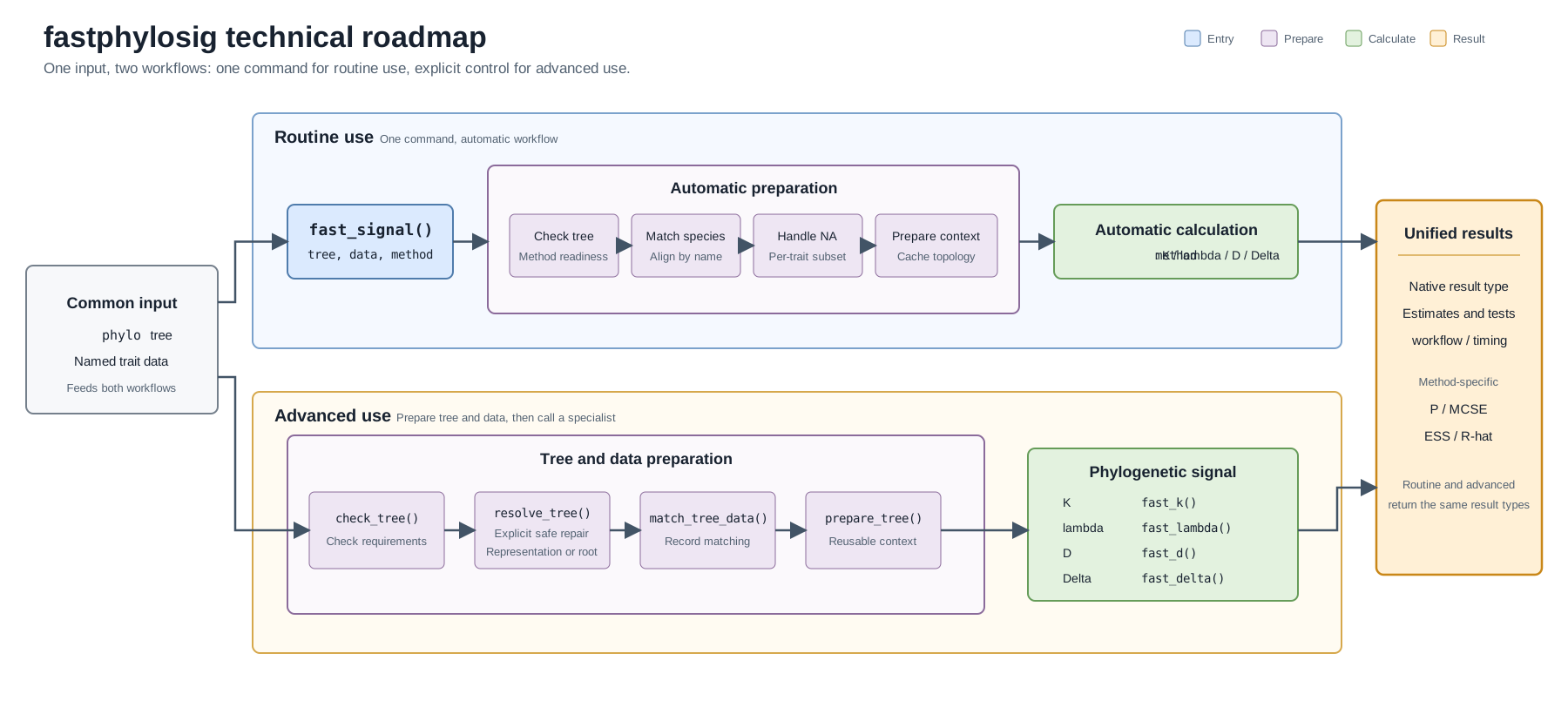
The tree and trait data feed either workflow. The general workflow performs the preparation boxes automatically. The advanced workflow exposes the same preparation order before a method-specific calculation. The editable draw.io source and Mermaid source are included for website use.
Advanced use: prepare, then calculate
Use the explicit path when you need an auditable tree/data record or controls that belong to one method:
checked <- check_tree(tree, signal = "K")
checked

# Safe representation changes only; an explicit outgroup is required if the
# selected method needs a root and the tree is unrooted.
tree_ready <- resolve_tree(tree, signal = "K")
matched <- match_tree_data(tree_ready, data = trait)
ctx <- prepare_tree(matched$tree)
After preparation, call the method-specific function directly:
| Function | Trait | Statistical target |
|---|---|---|
fast_k() |
continuous | Blomberg's K and permutation test |
fast_lambda() |
continuous | Pagel's lambda likelihood and LR test |
fast_d() |
binary | Fritz and Purvis D with random and Brownian nulls |
fast_delta() |
categorical | Delta, MCMC diagnostics, and permutation test |
k_fit <- fast_k(ctx, x = matched$data, test = TRUE, nsim = 999,
                return_sim = TRUE, progress = FALSE)
lambda_fit <- fast_lambda(ctx, trait, test = TRUE,
                          lambda_profile = TRUE, progress = FALSE)
binary <- stats::setNames(as.integer(trait > stats::median(trait)),
                          tree$tip.label)
d_fit <- fast_d(ctx, binary, test = TRUE, nsim = 99,
                return_sim = TRUE, keep_null = TRUE, progress = FALSE)
categorical <- stats::setNames(rep(c("a", "b", "c"), length.out = 30),
                               tree$tip.label)
delta_fit <- fast_delta(ctx, categorical, test = TRUE,
                        mcmc_sim = 10000, thin = 10, burn = 100,
                        return_sim = TRUE, progress = FALSE)
The method-specific controls are deliberately separate: K uses permutations and
simulation_chunk; lambda uses lambda_profile; D uses separate random and
Brownian state controls plus keep_null; Delta uses MCMC and permutation
controls. fast_ace() separately exposes the ancestral-state reconstruction
used by Delta. The result
classes and legacy fields remain stable.
Repeated analyses
Prepare a tree once when it will be used repeatedly:
ctx <- prepare_tree(tree)
X <- cbind(trait_1 = trait, trait_2 = trait + stats::rnorm(length(trait)))
fits <- fast_signal(ctx, data = X, method = "K", verbose = FALSE)
cache_info(ctx)
Preparation compiles topology and traversal data. Dense covariance,
Cholesky, and spectral payloads are not created by the production K, lambda,
D, or Delta paths. A prepared context is a snapshot: later changes to the
original phylo object do not update it. On every external reuse, the V2
context schema and an exact protected snapshot check the cached tree's tip
labels, edge matrix, branch lengths, and Nnode value before any cache or
numerical kernel is used. Changes to those fields are rejected. node.label
and other non-computational attributes are outside this integrity contract;
node.label may be reordered when internal nodes are renumbered.
V2 contexts can be saved with saveRDS() and reused after readRDS(); older
or unrecognized context schemas must be rebuilt with prepare_tree().
Tree and data details
check_tree() is read only. resolve_tree() may reorder edges and renumber
internal nodes on a copy when this changes representation only. V2 keeps tip
IDs and tip.label unchanged, assigns the root to n_tip + 1, orders child
subtrees by the exact UTF-8 byte order of their minimum descendant tip, and
numbers remaining internal nodes in canonical preorder. Edges are emitted in
canonical postorder while each branch length stays associated with its
biological child edge. The canonical computational representation,
fingerprint, and estimator outputs are invariant to valid internal-node
renumbering and edge-row order in the tested fixtures and locales. These
functions do not guess a biological root, select
an outgroup, invent or jitter branch lengths, resolve biological polytomies,
ultrametricize a tree, or silently delete tips. match_phylo_data() remains a
deprecated alias for match_tree_data().
Method boundaries are intentional:
- K and D require finite, strictly positive branches. D accepts rooted polytomies through its compatibility path but rejects unary internal nodes, including unary nodes exposed after matching or NA pruning.
- Lambda permits a zero internal branch only when its transformed terminal variances remain valid; zero terminal branches are rejected.
- Delta and
fast_ace()require a conventionally rooted, fully binary tree with finite, strictly positive branches. - Root placement is supplied by the user and can affect the statistic.
- Measurement-error input (
se != NULL) is not implemented.
Species identifiers should be unique vector names or matrix/data-frame row
names. Their input order need not match the tree: matched data are reordered
to tree-tip order. An unnamed input is accepted only when its entries or rows
already correspond to tree$tip.label order. Missing values are then handled per
trait. Each unique retained-tip mask is validated and cached once. Inputs are
not modified. A wrong positional order without identifiers cannot be detected
automatically and can assign traits to the wrong species.
Inference and diagnostics
K randomization supports explicit permutation matrices, bounded chunks, and
optional null retention. D reports separate P values and Bernoulli Monte Carlo
standard errors (MCSE_P_random and MCSE_P_Brownian) for its random and
Brownian nulls, using the finite successful count for each null. These fields
are NA when test = FALSE. D retains both null vectors only when both
return_sim = TRUE and keep_null = TRUE; their defaults are respectively
test and return_sim.
Lambda can retain an approximate likelihood profile. The nominal 95% interval
uses a regular grid and the cutoff
max(logL) - 0.5 * qchisq(0.95, df = 1); threshold crossings are linearly
interpolated. It is a grid/profile approximation, not an exact confidence
interval.
Delta defaults include test = FALSE, nsim = 1000, return_sim = test,
mcmc_sim = 10000, thin = 10, burn = 100, and model = "ARD"; therefore
no permutation P value or null vector is produced unless testing is enabled.
With test = TRUE, MCSE_P uses the number of finite successful permutations,
and return_sim = TRUE retains the Delta null vector. Interpret ESS, split
R-hat, MCSE_Delta, and, when present, MCSE_P together with the point
estimate. Fewer than two species shared globally by the tree and data is a
call-level error. After matching, a trait with fewer than two non-missing
species receives an explicit per-trait insufficient-data result; a completed
trait with 2--19 retained species contributes to one batch warning. Non-finite
diagnostics, ESS below 20, or split R-hat above 1.1 also produce one batch
warning. Warnings never rerun or extend the chain automatically.
Reproducibility and performance
Use set.seed() or controlled permutations for stochastic comparisons.
Record the package version, tree/data fingerprints, simulation counts,
threads, chunk sizes, and whether preparation time is included.
For throughput:
- Submit multiple traits as a matrix instead of looping in R.
- Reuse a
prepare_tree()context. - Keep null distributions only when they are needed.
- Use
ncoresfor K randomization, binary-tree D, or sufficiently large Delta permutation jobs; small parallel jobs may be slower than serial work. - Set
progress = FALSEto suppress progress stages and species-matching messages. Statistical warnings and errors are still signalled. Results retain timing metadata.
For stochastic parallel paths, replay requires the seed, explicit simulation
inputs (when supplied), and ncores to be held fixed. In particular, changing
Delta's process count repartitions worker RNG streams and is not guaranteed to
reproduce null draws or derived P/MCSE values draw for draw. Explicit
permutation/state matrices isolate the corresponding randomization step, but
Delta's MCMC fits remain stochastic. Record the worker configuration with the
result. Small jobs may be faster in serial.
Plotting
plot_signal(k_fit)
plot_signal(lambda_fit)
plot_signal(d_fit)
plot_signal(delta_fit)
Null-distribution plots require retained simulations. Use
return_sim = TRUE for K and Delta; D requires both return_sim = TRUE and
keep_null = TRUE.
What plot_signal() displays
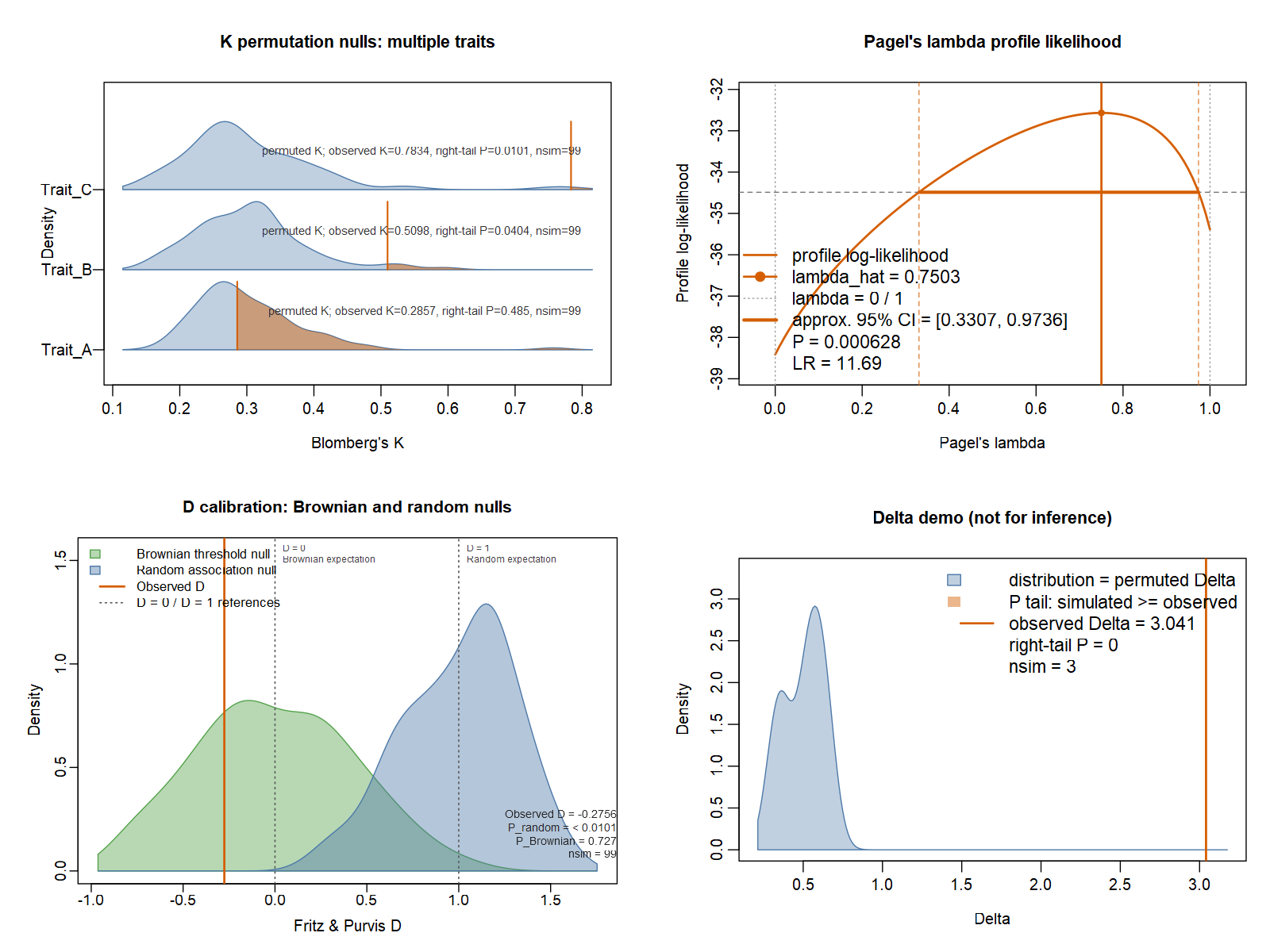
The examples show multi-trait K permutation ridges, a lambda likelihood
profile, D calibration against random and Brownian nulls, and a categorical
Delta permutation distribution. They are actual plot_signal() outputs from
version 0.3.0 on simulated demonstration data, not empirical findings.
See the gallery and reproducible R code for
single-trait K and separate D null displays, seeds, simulation settings,
and diagnostic caveats. The short Delta example is for illustration, not
scientific inference. These native web previews retain some annotation/curve
overlaps; they are not collision-free manuscript figures.
Compatibility and release status
The local 0.3.1 patch fixes D type-7 thresholds, numeric species identities, D plot null probabilities and tails, approximately ultrametric lambda boundaries, and long mask-cache identities. See patch notes. Its 50K regression covers preparation, subset caches, persistence, fallback grouping and K without permutations. It does not qualify all methods or simulation workloads at 50K. The historical figures and runtime evidence below remain evidence for 0.3.0; no new performance benchmark was run for 0.3.1.
The 0.3.0 release retains declared compatibility with R 4.1.0 and above. Its public API, estimator definitions, RNG stream, and thread policy are unchanged from 0.2.0. K values may differ at floating-point rounding scale; the Stage 5 numerical and release checks document the qualification boundary. Current performance evidence is from the production 0.3.0 implementation on Windows with R 4.6.1/Rtools 4.5, not from the Stage 3C prototype. Cross-platform, R-devel, and second-BLAS qualification remain outside this local validation scope.