rjsf
R Interface to Jump-Switch-Flow Simulation
An R interface to Jump-Switch-Flow (JSF), a hybrid
simulation framework for compartmental reaction models that combines
stochastic jump dynamics at low population sizes with deterministic flow
dynamics at high population sizes. Simulations are performed using the
'jsf' backend for 'Python' through 'reticulate', with structured R outputs
for inspection, summary, and plotting. The underlying methodology is
described in Germano et al. (2026)
rjsf
rjsf provides an R interface to Jump-Switch-Flow (JSF), a hybrid simulation framework for compartmental models that combines stochastic jump dynamics at low populations with deterministic flow dynamics at high populations.
Important: rjsf is an R interface; running simulations requires the Python Jump-Switch-Flow backend to be installed and accessible through reticulate.
The main function is jsf_simulate(), which lets users define compartmental reaction models in R, run simulations using the Python jsf backend, and return the output as either a regular data.frame or a structured JSFResult object.
Google Summer of Code
Development of rjsf commenced as part of the Google Summer of Code 2026 (GSoC 2026) program.
Installation
Once available on CRAN, you can install the released version of rjsf with:
install.packages("rjsf")
You can install the development version from GitHub with:
# install.packages("pak")
pak::pak("olivervu25/rjsf")
Running simulations also requires the Python Jump-Switch-Flow backend. See Python setup below.
Python setup
rjsf uses reticulate to communicate with the Python jsf package. The Python backend must therefore be installed in the same Python environment used by reticulate.
A recommended setup is to create a local virtual environment:
python3 -m venv .venv
source .venv/bin/activate

python -m pip install --upgrade pip setuptools wheel
python -m pip install numpy scipy pandas matplotlib python-libsbml
python -m pip install git+https://github.com/DGermano8/jsf
Then in R, point reticulate to that environment:
Sys.setenv(RETICULATE_PYTHON = ".venv/bin/python")

library(reticulate)
py_config()
Check that the Python jsf backend is available:
library(rjsf)

jsf_available()
A correctly configured environment should return:
[1] TRUE
Alternative setup using reticulate
You can also create and configure the Python environment directly from R:
library(reticulate)

virtualenv_create("rjsf-env")

py_install(
  packages = c(
    "numpy",
    "scipy",
    "pandas",
    "matplotlib",
    "python-libsbml"
  ),
  envname = "rjsf-env",
  method = "virtualenv"
)

py_install(
  packages = "git+https://github.com/DGermano8/jsf",
  envname = "rjsf-env",
  method = "virtualenv",
  pip = TRUE
)

use_virtualenv("rjsf-env", required = TRUE)
Then check:
library(rjsf)

jsf_available()
Quick example
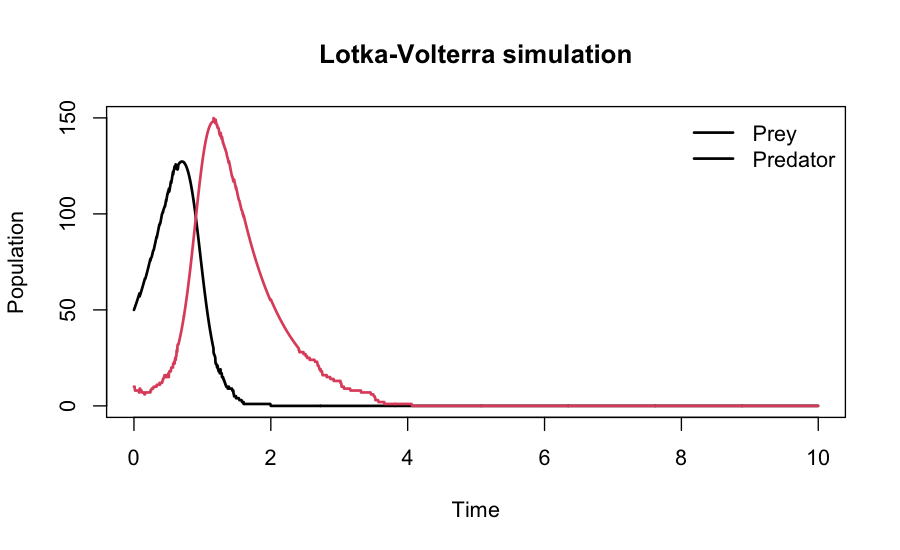
The following example simulates a Lotka-Volterra predator-prey system and returns a structured JSFResult object.
library(rjsf)
library(reticulate)

rates_lv <- reticulate::py_eval(
  "lambda x, t: [2.0 * x[0], 1.5 * x[1], 0.05 * x[0] * x[1]]"
)

result <- jsf_simulate(
  x0 = c(prey = 50, predator = 10),
  rates = rates_lv,
  reactant = matrix(
    c(
      1, 0,
      0, 1,
      1, 1
    ),
    ncol = 2,
    byrow = TRUE
  ),
  product = matrix(
    c(
      2, 0,
      0, 0,
      0, 2
    ),
    ncol = 2,
    byrow = TRUE
  ),
  do_disc = c(1, 1),
  t_max = 10,
  dt = 0.01,
  switching_threshold = c(30, 30),
  species_names = c("prey", "predator"),
  return_type = "JSFResult"
)

result
summary(result)
plot(result)
The simulated prey and predator trajectories can be visualised directly from the JSFResult object:
Output types
jsf_simulate() can return either a regular data frame:
df <- jsf_simulate(..., return_type = "data.frame")
or a structured JSFResult object:
result <- jsf_simulate(..., return_type = "JSFResult")
A JSFResult stores simulation trajectories and associated metadata and supports standard methods including:
print(result)
summary(result)
plot(result)
Vignettes
See the Getting started with rjsf vignette for complete Lotka-Volterra and SIR examples, including model specification, Python setup, simulation, and result inspection.
Citation
If you use rjsf in your work, please cite both the rjsf package and the original Jump-Switch-Flow methodology.
You can obtain the recommended citations in R with:
citation("rjsf")
The upstream Python implementation of Jump-Switch-Flow is available at: