ccva
Climate Change Vulnerability Assessment with Constrained Latent Models
A general framework for climate change vulnerability assessment
(CCVA) of any species and any dataset. Variables are tagged as exposure,
sensitivity or adaptive capacity; each component is computed from its own
predictors by a chosen method; and the three components are combined into
vulnerability. Methods range from the conventional weighted index of
Ofori et al. (2017)
ccva

Climate change vulnerability assessment with constrained latent models.
ccva is a general framework for climate change vulnerability assessment
(CCVA) of any species and any dataset. It keeps the standard framework —
vulnerability as a function of exposure, sensitivity and adaptive
capacity — and puts it on a statistical footing:
- Any data. Tag the columns of any dataset as indicators of the three components and name the observable outcomes (IUCN status, population trend, range change). Each component can use different inputs.
- Each component from its own predictors, by the method its data call for: Ofori-style 1–3 scoring, continuous indices, PCA, or penalised regression (LASSO / elastic net) when predictors outnumber species, as with genomic data.
- Vulnerability by a choice of models: the conventional weighted index of Ofori et al. (2017), a shape-constrained additive model, a latent-variable structural equation model in which vulnerability is inferred from observable proxies, or a penalised two-stage model.
- Constraints as the core contribution. Ecological knowledge is imposed explicitly on predictors (sign, bounds, equality, fixed values) and on each component's role (direction, bounds, adaptive capacity as a moderator only). The same constraint carries across every model that can express it.
- Assessment, not just a ranking: internal-consistency diagnostics, validation against observed outcomes, bootstrap and weight-based uncertainty for scores and ranks, outcome-calibrated class cut-offs, and a plot for every step.
- Extensible. New component methods, combination methods and constraint
types register through
ccva_register().
Installation
# install.packages("remotes")
remotes::install_github("DoostiH/ccva", build_vignettes = TRUE)
ccva needs R ≥ 4.1 with ggplot2 and lavaan. The shape-constrained
model uses scam and the penalised methods use glmnet (both
suggested; install them to use those methods).
A first assessment
library(ccva)

# 300 simulated species with a known latent structure
d <- ccva_sim_data()

# Is each component internally consistent?
ccva_check(d)

# The conventional Ofori et al. (2017) index
ofori <- ccva_combine(d, "weighted", component_method = "ordinal")

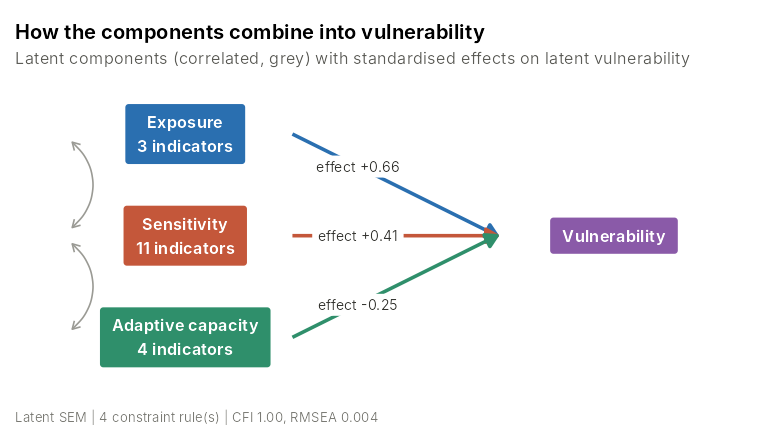
# Vulnerability as a latent variable, with the default ecological constraints
latent <- ccva_combine(d, "latent",
  shared_error = list(c("E1_risk", "E2_risk", "E3_risk")))

ccva_plot(latent, "structure")
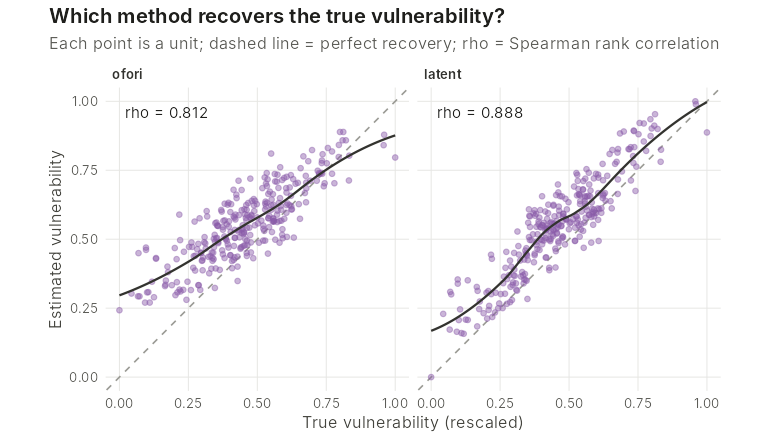
cmp <- ccva_compare(ofori = ofori, latent = latent)
cmp
#>  method  iucn pop_trend range_change V* (truth) class_agreement
#>   ofori 0.580     0.584        0.451      0.812            1.00
#>  latent 0.745     0.748        0.481      0.888            0.85
ccva_plot(cmp, "truth")
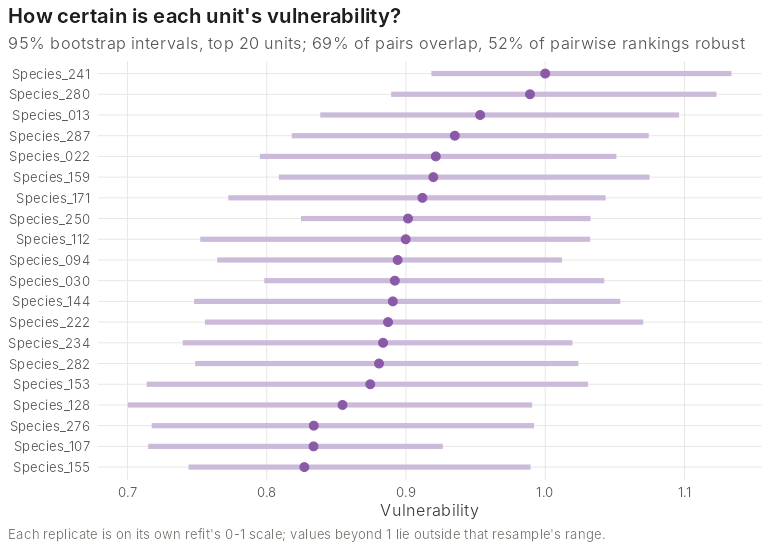
unc <- ccva_uncertainty(latent, "bootstrap", R = 200)
ccva_plot(unc, "intervals")
Imposing constraints
cons <- ccva_constraints(              # added on top of the defaults:
  constrain_moderator(),               # adaptive capacity moderates only
  constrain_equal(c("a1_genetic", "a2_bodysize")),
  constrain_fixed("s7_repromode", 0),  # drop an indicator
  constrain_bounds("exposure", 0, 2))  # bound a component's effect

ccva_combine(d, "shape", constraints = cons)
Constraints matter most at the sample sizes typical of CCVAs. In simulations with 50 species the constrained latent model converged in every fit, while free estimation failed to converge in 10–28% of fits (identical estimates when both converge). Sign constraints on loadings also stop latent scores from coming out upside down.
Causal links and calibrated risk
Adaptive capacity often acts through the other components — range shifts change exposure, plasticity or evolution changes sensitivity. Declaring these links makes the causal hypothesis explicit, avoids double-counting, and splits the effect of adaptive capacity into direct and indirect parts:
causal <- ccva_combine(d, "latent",
  shared_error = list(c("E1_risk", "E2_risk", "E3_risk")),
  constraints = ccva_constraints(
    constrain_link("adaptive", "exposure", "-"),
    constrain_link("adaptive", "sensitivity", "-")))

# From rankings to the probability of an observed outcome, with intervals
risk <- ccva_calibrate(causal, outcome = "iucn",
                       uncertainty = ccva_uncertainty(causal))
Functions at a glance
| Stage | Functions |
|---|---|
| Data | as_ccva(), ccva_simulate(), ccva_sim_data(), ccva_sdm_exposure(), ccva_thermal_margin(), ccva_adjust_method() |
| Components | ccva_exposure(), ccva_sensitivity(), ccva_adaptive() |
| Vulnerability | ccva_combine(), ccva() |
| Constraints | ccva_constraints(), constrain_sign(), constrain_bounds(), constrain_equal(), constrain_fixed(), constrain_moderator(), constrain_shape(), constrain_link() |
| Assessment | ccva_recommend(), ccva_check(), ccva_validate(), ccva_compare(), ccva_uncertainty(), ccva_calibrate(), ccva_classify(), ccva_rank(), ccva_aggregate() |
| Outputs | ccva_plot(), ccva_report() |
| Extending | ccva_register(), ccva_methods() |
See vignette("ccva") for the full walkthrough and vignette("framework") for the
recommended workflow (method matching, assay control, formative components,
causal links, calibrated risk, spatial prioritisation) step by step.
Roadmap
- A unified Bayesian latent model combining latent vulnerability, shrinkage priors for high-dimensional predictors, measurement error and shape constraints in one fit.
- More exposure methods (climate velocity, niche departure) and mechanistic sensitivity methods (thermal safety margins from fitted performance curves).
- A contributed library of constraints and structural links.
Contributions are welcome — open an issue to discuss a new method or constraint.
References
Ofori, B. Y., Stow, A. J., Baumgartner, J. B. and Beaumont, L. J. (2017). Influence of adaptive capacity on the outcome of climate change vulnerability assessment. Scientific Reports 7, 12979. doi:10.1038/s41598-017-13245-y
Author
Hassan Doosti, Macquarie University ([email protected])
Licence
GPL (≥ 3). All data shipped with the package are simulated and have no biological meaning.