grattan
Australian Tax Policy Analysis
Utilities to cost and evaluate Australian tax policy, including fast projections of personal income tax collections, high-performance tax and transfer calculators, and an interface to common indices from the Australian Bureau of Statistics. Written to support Grattan Institute's Australian Perspectives program, and related projects. Access to the Australian Taxation Office's sample files of personal income tax returns is assumed.

grattan
Utilities for costing and evaluating Australian tax policy, including high-performance tax and transfer calculators, a fast method of projecting tax collections from ATO sample files, and an interface to common indices from the Australian Bureau of Statistics. Written to support Grattan Institute’s Australian Perspectives program.
Overview
install.packages("grattan")
library(grattan)
income_tax
Calculates the income tax for a given taxable income and financial year:
income_tax(50e3, "2015-16")
## [1] 8547
With sample files
income_tax is designed to work well with the ATO’s sample files. You
can obtain the sample files from my repo:
# install.packages("taxstats", repos = "https://hughparsonage.github.io/tax-drat")
library(taxstats)

library(hutils)
library(data.table)
library(magrittr)
library(ggplot2)
Simply pass the sample file to .dots.ATO and the complexities of
things like Medicare levy and the Seniors and Pensioners Tax Offset are
handled for you. For example:
s1314 <- as.data.table(sample_file_1314)
s1314 %>%
  .[, tax := income_tax(Taxable_Income, "2013-14", .dots.ATO = s1314)] %>%
  .[, .(Taxable_Income, tax)]
##         Taxable_Income       tax
##      1:           4800     0.000
##      2:         126122 36503.970
##      3:          39742  4655.410
##      4:         108123 29574.355
##      5:          85957 21040.445
##     ---
## 258770:          24462  1111.710
## 258771:          37055  3701.525
## 258772:          45024  6530.520
## 258773:           5134     0.000
## 258774:          46368  7007.640
model_income_tax: modelling changes to personal income tax
While income_tax is designed to inflexibly return the tax payable as
legislated, model_income_tax is designed to calculate income tax when
changes are made. For example,
s1314 %>%
  # reduce top threshold from 180,000 to 150,000
  model_income_tax(ordinary_tax_thresholds = c(0, 18200, 37000, 80000,
                                               150e3),
                   baseline_fy = "2013-14") %>%
  .[, .(Taxable_Income, baseline_tax, new_tax)]
##         Taxable_Income baseline_tax   new_tax
##      1:           4800        0.000     0.000
##      2:         126122    36503.970 36503.970
##      3:          39742     4655.410  4655.410
##      4:         108123    29574.355 29574.355
##      5:          85957    21040.445 21040.445
##     ---
## 258770:          24462     1111.710  1111.710
## 258771:          37055     3701.525  3701.525
## 258772:          45024     6530.520  6530.520
## 258773:           5134        0.000     0.000
## 258774:          46368     7007.640  7007.640
project
Given a sample file, we can project forward a number of years
s1617 <- project(s1314, h = 3L)
or to a particular financial year
s1718 <- project_to(s1314, "2017-18")
Together with model_income_tax, this allows us to make
point-predictions of future years. The function revenue_foregone
prettily prints the resultant revenue:
sample_file_1314 %>%
  project_to("2018-19") %>%
  model_income_tax(baseline_fy = "2017-18",
                   ordinary_tax_thresholds = c(0, 18200, 37000, 87000,
                                               150e3)) %>%
  revenue_foregone
## [1] "$1.7 billion"
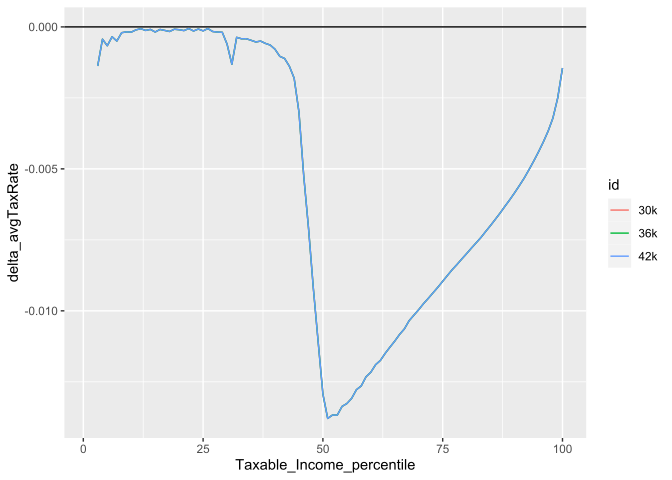
compare_avg_tax_rates:
Create comparison of average tax rates:
lapply(list("30k" = 30e3,
            "36k" = 36e3,
            "42k" = 42e3),
       function(T2) {
         model_income_tax(s1718,
                          baseline_fy = "2017-18",
                          ordinary_tax_thresholds = c(0,
                                                      18200,
                                                      T2,
                                                      87000,
                                                      180e3))
       }) %>%
  rbindlist(idcol = "id",
            use.names = TRUE,
            fill = TRUE) %>%
  compare_avg_tax_rates(baseDT = .[id %ein% "36k"]) %>%
  ggplot(aes(x = Taxable_Income_percentile,
             y = delta_avgTaxRate,
             color = id,
             group = id)) +
  geom_hline(yintercept = 0) +
  geom_line()
## Warning: Removed 6 row(s) containing missing values (geom_path).
NEWS
2023.0
_inflatorfunctions have been moved to grattanInflator, breaking (for example)cpi_inflator_general_datewhich are nowcpi_inflator.
2.0.0.0
Breaking changes
-
income_taxno longer acceptsfamily_status,n_dependants,allow.forecastsand.debug -
model_income_taxArguments prefixedBudget_andlito_are deprecated and nowoffsets = set_offsetsare preferred. However, usingSystemwithincome_taxis likely to be just as convenient. -
litoandlmitono longer accept varying parameters, butlmitois now exported -
sapto_rcpp,income_tax_sapto,new_income_tax,new_medicare_levy, andnew_saptohave now been removed. UseSystem. -
The transfer functions have been removed as they became unreliable / difficult to maintain. See repository
hughparsonage/grattanTransfersfor possible future developmentage_pensioncarer_paymentchild_care_subsidyenergy_supplementfamily_tax_benefitmodel_child_care_subsidymodel_rent_assistancenewstart_allowancepension_supplementrent_assistancestudent_repaymentunemployment_benefityouth_allowanceyouth_unemployment
-
The
grattan v2package will be more focused on income tax with other elements being spun off into other packages. In particular,_inflatorfunctions and related forecasting methods, functions essentially accessing ABS data, and functions relating to tranfers will be put in other packages, and imported later. Functions that are made available in thegrattanNAMESPACE may have changes to their API when this happens.
API changes
income_taxnow usesSystemto define the tax system
Other changes
model_income_taxdoes not throw an error for incorrect specification oflito_arguments (which are deprecated)age_groupernow works with long vectors containing missing values
1.9.0.10
- New data changes to 2022
rent_assistance()example no longer works because of outdated data.
Breaking changes anticipated in 2.0.0.0
income_taxandmedicare_levyno longer acceptfamily_statusas an input, since it was giving misleading results. Use.dots.ATOwith appropriate variables to define the spouse’s income or the number of children.income_taxgives a slightly different error message when an invalid financial year is passed. Previously “not in correct form”, now “not a valid financial year”.useABSConnection = TRUEis no longer supported because of ABS server issues
1.9.0.8
- Maintenance release for the new financial year.
1.9.0.0
New features
- 2017-18 sample file now contemplated as an input to
project projectnow hasr_super_balanceto project super balances by a user-supplied factor, rather than a hard-coded 1.05.- Modelling superannuation changes now accepts contributions taxes relative to marginal rates.
Data
- Data updated to 2020-06-30
Internal:
package:rsdmxis now Suggested, since a dependency has been orphaned.
1.8.0.1
Bug fixes
- Fixed issue with stringsAsFactors = FALSE being inconsistently applied with R 4.0
Data
- Update wage, CPI, and labour force data
1.7.1.4
- Fixed minor error that affected tax liability calculations for 2010-11 and 2011-12 financial years
1.7.1.3
grattan’s tax modelling functions now work with the 2016-17 ATO sample file
1.7.1.1
grattannow depends on R 3.5.0 due to serialization format version 3 becoming the default in R 3.6.0.cpi_inflatorfails more gracefully when the ABS’s website is not available
1.7.1.0
Bug fixes
income_taxnow gives consistent results modulo the existence of completely empty columns that are inputs forsapto(#158)income_taxwill work if.dots.ATOis a non-data.table data.frame.model_income_tax:- Correctly imputes SAPTO vs non-SAPTO family thresholds when both provided.
sapto_rcppis now more careful about passing length-one vectors to vectorized C++ functions.
projectnow correctly prioritizesexcl_varsover variables with otherwise predefined uprating mechanisms (such asSw_amt).
New functions:
awotefor weekly earnings
Enhancements:
age_groupercan now have a custom first label prefix, and is much faster whenlength(age)is large.income_taxnow emits a warning when both age and.dots.ATOare provided, indicating thatagewill be ignored.- The data has been updated to 2019-02-23.
Internal
mutate_ntileandweighted_ntilenow use thehutilsequivalents. This broke 3 unit tests because of the specific phrasing of some error messages.- The vignette requires pandoc > 2.4. Some chunks have been refactored to avoid excess memory usage.
1.7.0.0
Bug fixes
- Fixed failing interaction between temporary budget repair levy and small business tax offset in 2016-17.
small_business_tax_offset()is now always positive, fixing the original misinterpretation of the legislation whereby negative business income resulted in a negative offset.*_inflatorfunctions now return correct results for non-standard but supported financial years.inflatorno longer fails whento_fyis length > 1 and unordered.
New features
mutate_ntileandmutate_weighted_ntilefor adding quantile columns- New welfare functions (usable for the 2015-16 financial year)
age_pension,carer_paymentcarers_allowanceenergy_supplementfamily_tax_benefitnewstart_allowancepension_supplementrent_assistancethe Commonwealth Rent Assistancemodel_rent_assistanceas experimental function for modelling changes to rent assistance.youth_allowance()now available, though limited
compare_avg_tax_rates: create a difference in average tax rates between multiple models and a baseline tax, by percentile.install_taxstats()as a convenient means to install the non-CRANtaxstatsdependency.
Enhancements
prohibit_vector_recycling()and friends return more informative error messages.- Added default values to the following functions:
income_tax,income_tax_sapto: the default value for fy.year is the current financial yearcpi_inflator,lf_inflator_fy,wage_inflator: if both from_fy and to_fy are missing, the default values become the previous and current financial years respectively. If only one of the two are missing, an error appears.
income_taxis about twice as fast since 1.6.0.0: 1.5-2.0s down from 3.0-3.7s on the 100% population (13 million)inflatorandcpi_inflator,lf_inflator_fy, andwage_inflatorare now much faster when eitherfrom_fyorto_fyhave more than 100,000 elements:
set.seed(19952010)
from_fys <- sample(yr2fy(1995:2010), size = 1e6, replace = TRUE)
microbenchmark(cpi_inflator(from_fy = from_fys, to_fy = "2015-16"))
# Old
Unit: seconds
                                                expr      min      lq     mean   median       uq
 cpi_inflator(from_fy = from_fys, to_fy = "2015-16") 1.519483 1.54438 1.550628 1.549735 1.554507
      max neval
 1.661502   100

# New
Unit: milliseconds
                                                expr      min       lq     mean   median       uq
 cpi_inflator(from_fy = from_fys, to_fy = "2015-16") 40.71753 41.94061 47.93162 42.93946 48.08461
      max neval
 191.3497   100
Potentially breaking changes
yr2fy(x)no longer works for x = 1900L, despite a unit test, for the sake of performance.
  #> Last change: NAMESPACE at 2018-08-19 14:47:14 (4 mins ago).
  #> Unit: milliseconds
  #>       expr min  lq mean median  uq max neval cld
  #>   yr2fy(z)  75  88   98     90 101 161   100  a
  #>  .yr2fy(z) 274 286  298    297 302 359   100   b
Use yr2fy(x, assume1901_2100 = FALSE) if you need the old behaviour.
Misc/Internal
taxstats1516is now a suggested dependency.
1.6.0.0
2018-05-08
- Never-legislated Medicare levy change in 2019-20 has been reverted
- Budget 2018:
model_income_tax()no longer coercesWEIGHTto integer.- New arguments to support Budget 2018:
lito_multiPermits multiple pieces to the linear offset.Budget2018_lamingtonThe Low And Middle Income Tax Offset proposed in the Budget 2018 budget.Budget2018_lito_202223The proposed change to LITO from 2022-23.Budget2018_watrThe offset proposed by the Opposition the Budget Reply.sbto_discountAllows modification of the small business tax offset.clear_tax_colsBy default, old tax columns are deleted.warn_upper_thresholdsIf changed toFALSEallows the automatic changes to be applied without warning.
- New functions:
progressivity()for Gini-based measure of the progressivity of income taxrevenue_foregone()as a convenenience for returning the revenue foregone from a modelled sample file.
- Routine changes:
- ABS data updated as of 2018-05-21.
1.5.3.6
2018-02-21
- Labour force data and wage price index updated to 2018-02-21.
- Update as requested to fix failing unit tests relying on non-standard packages.
1.5.3.1
2018-01-22
New features:
- New function
model_income_taxwhich attempts to provide every lever of the income tax system that is visible from the tax office’s sample files. Users can model the sample file by changing single parameters to observe the effect on tax collections. small_business_tax_offset: Include the small business tax offset as a standalone function and withinincome_tax.
Other user-visible changes
projectandproject_tono longer requirefy.year.of.sample.file. However, they expect the supplieddata.frameto be compatible with the sample file provided. Failling to provide a sample file with the expected number of rows or not providing a sample file with a valid number of rows is a warning, which can be silenced bycheck_fy_sample_file = FALSE.
Data:
- Update labour force data to November 2017
- Internal projection tables have been updated for the latest (2014-15) sample file.
Other changes
mgcvwas used but not declared in Suggests: Thanks to BDR for reporting.- (internal) Extend
prohibit_vector_recyclingto return the maximum permissible length of a list of vectors.
1.5.2.5
2017-11-16
- Update wage data to 2017-Q3
- Update labour force data to 2017-09
- (internal) The
lf_trendinternal data table used to report the labour force in thousands of persons, as the ABS does. This seemed a bit strange, so nowobsValueuses integers (i.e. just the labour force). - Vignettes now install
taxstatsto a temporary directory if not already installed, rather than the user or system’s library.
2017-10-27
- Update CPI data
- Fix wage data
1.5.2.3
2017-10-21
- Update labour-force data
1.5.2.0
2017-10-19
- New internal C++ functions for
income_tax, and related functions - BTO function now uses tax scales from the Income Tax Regulations
1.5.1.2
2017-10-15
- Optional argument
ageinincome_taxnowNULLrather than42.
The default argument continues to result in SAPTO being not applied if.dots.ATO. However, if.dots.ATOis supplied (and the age variable has not been removed from it), the individuals’ SAPTO eligibility is determined by the age variable in.dots.ATO, rather than setting each individual’s SAPTO to 0.
2017-08-30
- Update labour force data. Avoid segfault in separate package in unit test.
- Added a
NEWS.mdfile to track changes to the package.
2017-08-16
- Update wage, CPI, labour force data
2017-07-02
- Update wage and labour force data
- Fix breaking build due to change in dplyr API
CRAN Notes
This is a package update
Test results
0 ERRORS | 0 WARNINGS | 1-2 NOTEs
NOTES:
Notes for taxstats are routine