nphPower
Sample Size Calculation under Non-Proportional Hazards
Performs combination tests and sample size calculation for
fixed design with survival endpoints using combination tests under either
proportional hazards or non-proportional hazards. The combination tests
include maximum weighted log-rank test and projection test. The sample
size calculation procedure is very flexible, allowing for user-defined
hazard ratio function and considering various trial conditions like
staggered entry, drop-out etc. The sample size calculation also applies to
various cure models such as proportional hazards cure model, cure model with
(random) delayed treatments effects. Trial simulation function is also provided
to facilitate the empirical power calculation. The references for
projection test and maximum weighted logrank test include Brendel et al. (2014)
package: nphPower
Package: nphPower provides functions to perform combination test including maximum weighted logrank test (MWLR) and projection test, to calculate sample size with MWLR in a simulation-free approach allowing for staggered entry, drop-out etc, to visualize the design parameters and to simulate survival data with flexible design input.
Installation
You can install the released version of nphPower from CRAN with:
install.packages("nphPower")
library("nphPower")
And the development version from GitHub with:
# install.packages("devtools")
#devtools::install_github("hcheng99/nphPower")
Example 1 - perform maximum weighted logrank test
This is a basic example which shows you how to perform maximum weighted logrank test.
Load the lung data and only keep columns for analysis.
lung <- nphPower::lung
tmpd <- with(lung, data.frame(time = SurvTime, stat = 1-censor, grp = Treatment))
Generate the weight functions for maxcombo test
wmax <- gen.wgt(method = "Maxcombo")
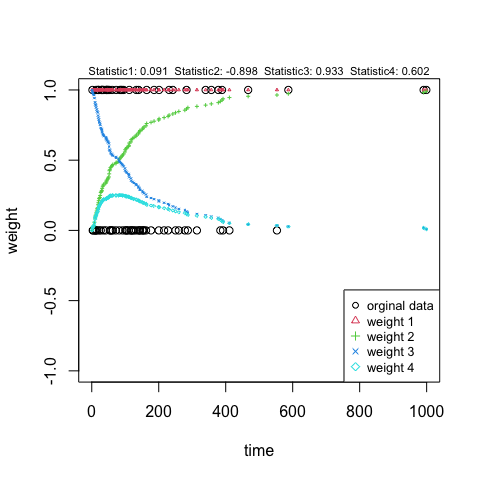
Perform the test using pooled Kaplan-Meier estimate of CDF as base function and visualize the weight functions
t1 <- MaxLRtest(tmpd, Wlist = wmax, base = c("KM"),
  alternative = c("two.sided"))
plot(t1)
 ##
Example 2 - sample size under proportional hazard The design setting is:
5 years’ entry time and 5 years’ follow-up time; Median survival for
control group is 10 years. The hazard ratio comparing treatment and
control is 0.5.
##
Example 2 - sample size under proportional hazard The design setting is:
5 years’ entry time and 5 years’ follow-up time; Median survival for
control group is 10 years. The hazard ratio comparing treatment and
control is 0.5.
t_enrl <- 5; t_fup <- 5 ; lmd0 <- -log(0.2)/10 ; HR <- 0.5
eg1 <- pwr2n.LR(method = "schoenfeld", lambda0 = lmd0,
  lambda1 = lmd0*HR, entry = t_enrl, fup = t_fup)
#> ------------------------------------------
#>  -----Summary of the Input Parameters-----
#> ------------------------------------------
#>        __Parameter__      __Value__
#>              Method     schoenfeld
#>  Lambda1/Lambda0/HR 0.08/0.161/0.5
#>          Entry Time              5
#>      Follow-up Time              5
#>    Allocation Ratio              1
#>        Type I Error           0.05
#>       Type II Error            0.1
#>         Alternative      two.sided
#>  Drop-out Parameter   Not Provided
#> ------------------------------------------
#>  -----Summary of the Output Parameters-----
#>  ------------------------------------------
#>                __Parameter__ __Value__
#>            Number of Events    87.479
#>  Number of Total Sampe Size   153.173
#>          Overall Event Rate     0.571
Example 3 - sample size under nonproportional hazard
Design setting: patients are enrolled within 12 months and the last enrolled patient has at least 18 months’ follow-up. The medial survival time for control group is 12 months. The treatment has delayed effects. The hazard ratio is 0.75 after 6 months. Maxcombo test is used.
t_enrl <- 12; t_fup <- 18; lmd0 <- log(2)/12
f_hr_delay <- function(x){(x<=6)+(x>6)*0.75}
f_haz0 <- function(x){lmd0*x^0}
snph1 <- pwr2n.NPH(entry = t_enrl, fup = t_fup, Wlist = wmax,
 k = 50, ratio = 2, CtrlHaz = f_haz0, hazR = f_hr_delay)
#> -----Summary of the Input Parameters-----
#>          parameter     value
#>             Method     MaxLR
#>         Entry Time        12
#>     Follow-up Time        18
#>   Allocation Ratio         2
#>       Type I Error      0.05
#>      Type II Error       0.1
#>        Alternative two.sided
#>  Number of Weights         4
#> -----Summary of the Output Parameters-----
#>                    parameter    value
#>            Number of Events 1198.779
#>  Number of Total Sampe Size 1720.967
#>            Asymptotic Power    0.900
#>          Overall Event Rate    0.697
Example 4 - trial data simulation
A time-to-event data set with settings in example 3 is simulated.
N <- round(snph1$totalN, digits = 0)
set.seed(12345)
simu1 <- simu.trial(type = "time", trial_param = c(N,t_enrl,
  t_fup), bsl_dist = "weibull", bsl_param = c(1,lmd0),
  HR_fun = f_hr_delay, ratio = 1)
#> Notes: Drop-outs are not considered in the simulation.
#>  -------- Summary of the Simulation --------
#>                 parameter value
#> 1             Trial Type:  time
#> 2             Entry Time:    12
#> 3 Maximum Study Duration:    30
#> 4     Number of Subjects:  1721
#> 5       Number of Events:  1259
More functions can be found in the package.