vennabers
Venn-Abers Classification and Regression Calibration
Calibrates the predictions of classification and regression
models with Venn-Abers predictors. A Venn-Abers predictor turns the
score of any model into a pair of probabilities that contains a
calibrated value when the observations are independent and identically
distributed (Vovk and Petej, 2014,
vennabers


vennabers calibrates model predictions in R with Inductive or Cross
Venn-Abers methods. It supports binary classification, multiclass
classification (one-vs-one or one-vs-rest) and regression. Start with
Venn-Abers methods and their
guarantees
for what the predictors compute and what they guarantee.
You can calibrate predictions from a model you already have, or let optional tidymodels workflows fit the model, create the calibration splits and tune the complete procedure.
Installation
vennabers requires R 4.5 or later. Install the released version from
CRAN:
install.packages("vennabers")
Or install the development version from GitHub:
# install.packages("pak")
pak::pak("RMKruse/vennabers")
Calibrating supplied predictions needs no additional packages. The
tidymodels workflows and the vignettes use the optional packages listed
under Suggests in DESCRIPTION.
Example
Fit a calibrator with probabilities from a model trained on separate data, then calibrate probabilities for new observations:
library(vennabers)

truth <- c(FALSE, TRUE, FALSE, TRUE)
uncalibrated <- c(0.1, 0.4, 0.35, 0.8)
calibrator <- venn_abers(truth, uncalibrated)

prediction <- predict(calibrator, c(0.2, 0.5, 0.9))
prediction
#>       lower upper probability
#> 1 0.0000000   0.5   0.3333333
#> 2 0.5000000   1.0   0.6666667
#> 3 0.6666667   1.0   0.7500000
brier_score(c(FALSE, TRUE, TRUE), prediction$probability)
#> [1] 0.09490741
prediction holds the lower and upper Venn-Abers bounds and a
regularized probability. The bounds are not confidence intervals.
With tidymodels installed, calibrated_workflow() trains a workflow and
its calibrator together:
data <- data.frame(
  x = sin(1:80),
  truth = factor(rep(c("yes", "no", "no", "yes"), 20))
)
base <- workflows::workflow() |>
  workflows::add_formula(truth ~ x) |>
  workflows::add_model(parsnip::logistic_reg(engine = "glm"))

fit <- calibrated_workflow(base, outcome = "truth", seed = 42) |>
  generics::fit(data)
predict(fit, data.frame(x = c(-0.5, 0.5)), type = "prob")
Calibration at a glance
A logistic regression that is linear in x cannot follow event
probabilities of plogis(x^3): it ranks cases correctly, but its
probabilities are off. Venn-Abers calibration on separate calibration
data corrects them. The CORP reliability diagrams compare both on a
third, independent assessment set; a well calibrated method follows the
diagonal inside the gray band.
set.seed(1)
simulate <- function(n) {
  x <- rnorm(n)
  data.frame(x = x, truth = runif(n) < plogis(x^3))
}
training <- simulate(500)
calibration <- simulate(1000)
assessment <- simulate(5000)

model <- glm(truth ~ x, family = binomial(), data = training)
score <- function(data) predict(model, data, type = "response")
calibrator <- venn_abers(calibration$truth, score(calibration))
calibrated <- predict(calibrator, score(assessment))$probability

par(mfrow = c(1, 2))
corp_plot(assessment$truth, score(assessment), seed = 1,
          main = "Logistic model")
corp_plot(assessment$truth, calibrated, seed = 1,
          main = "Venn-Abers calibrated")
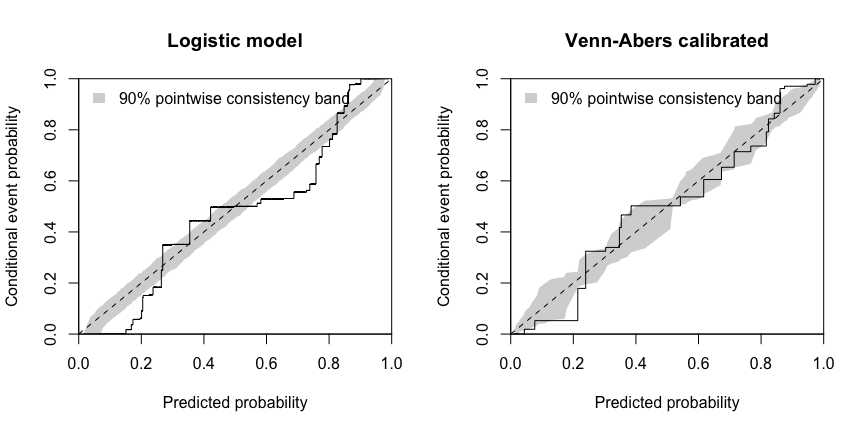
vignette("comparison") adds Platt scaling and isotonic calibration and
states what one simulated data set can and cannot show.
Overview
| Task | Function |
|---|---|
| Calibrate binary or multiclass probabilities | venn_abers(), cross_venn_abers() |
| Calibrate numeric predictions | venn_abers_regression(), cross_venn_abers_regression() |
| Fit and calibrate a tidymodels workflow | calibrated_workflow() |
| Calibrate an already fitted workflow | calibrate_workflow() |
| Use your own fit and predict functions in a workflow | model_adapter() |
| Inspect a fitted calibrator | plot() |
| Score and assess calibration | brier_score(), log_loss(), calibration_plot(), corp_plot(), corp_decomposition_plot(), regression_plot() |
Documentation
The package website collects the
guides, the function reference and the example scripts. Start with
?vennabers for the package overview and with the method guide, then
follow the practical guides:
- Venn-Abers methods and their
guarantees:
vignette("method", package = "vennabers") - Venn-Abers, Platt and isotonic calibration
compared:
vignette("comparison", package = "vennabers") - Calibrating supplied
predictions:
vignette("manual-calibration", package = "vennabers") - Training and freezing calibrated
workflows:
vignette("workflows", package = "vennabers") - Tuning and assessing the complete
procedure:
vignette("tuning", package = "vennabers") - Diagnose and assess
calibration:
vignette("diagnostics", package = "vennabers")
Runnable example scripts for every interface are collected in
?vennabers_examples, and learned postprocessing is covered in
?workflow_postprocessing.
Relationship to Python venn-abers
This is an independent R implementation. Its shared core results are
checked against reference outputs of the Python package
venn-abers.
PARITY.md
separates numerical parity from R extensions, documented deviations and
accepted limits.
Stability
From 1.0.0 on, the user-facing functions, their arguments and defaults, and their documented output formats stay compatible throughout 1.x. See NEWS for the full promise.
Contributing
Report problems in the issue tracker. See CONTRIBUTING for running the tests and building the documentation.
Citation
Cite the package and the method papers you use with
citation("vennabers").
References
- Vovk and Petej (2014). Venn-Abers predictors. doi:10.48550/arXiv.1211.0025
- Vovk, Petej and Fedorova (2015). Large-scale probabilistic predictors with and without guarantees of validity. doi:10.48550/arXiv.1511.00213
- Manokhin (2017). Multi-class probabilistic classification using inductive and cross Venn-Abers predictors. https://proceedings.mlr.press/v60/manokhin17a.html
- Dimitriadis, Gneiting and Jordan (2021). Stable reliability diagrams for probabilistic classifiers. doi:10.1073/pnas.2016191118
License
MIT