vrpr
Vehicle Routing Problem Solver Built on 'PyVRP'
A 'tidyverse'-style interface to high-performance vehicle routing problem (VRP) solving. Vendors the C++ core of the 'PyVRP' solver (< https://github.com/PyVRP/PyVRP>) and rewires it through 'cpp11', with no 'Python' runtime dependency. Supports the capacitated VRP, time windows, multiple depots, heterogeneous fleets, prize-collecting and multi-trip variants, driven by an iterated local search metaheuristic.
vrpr 






A production-grade vehicle routing problem (VRP) solver for R.
vrpr brings the state-of-the-art PyVRP solver to R. It vendors PyVRP's high-performance C++ core and rewires it with cpp11, wrapped in an idiomatic, tidyverse-style API: a pipe-friendly model builder, data in tibbles, and logging via cli — with no Python runtime dependency.
It fills a real gap in the R ecosystem: there are ompr, ROI, lpSolve, igraph and dodgr,
but no modern, strong, friendly solver for production vehicle routing.
Highlights
- All the classic VRP variants, from one tidy interface: capacitated VRP, time windows (VRPTW), heterogeneous fleets, multiple depots (MDVRP), prize-collecting with optional clients and mutually exclusive groups, simultaneous pickup & delivery / backhaul, paired pickup-and-delivery shipments (PDP/PDPTW), and multi-trip routes.
- Fast — the search runs entirely in PyVRP's C++ core (iterated local search with late-acceptance hill-climbing). No Python required.
- Verified parity with PyVRP — identical objective, and on the X-n101-k25 benchmark (optimum
27591) both reach the optimum in 20 s (see
tools/benchmark/). - Reads standard instances (VRPLIB / TSPLIB and Solomon) and plots solutions with ggplot2.
Installation
Install the released version from CRAN:
install.packages("vrpr")
Or the development version from GitHub:
# install.packages("pak")
pak::pak("StrategicProjects/vrpr")
A C++20 toolchain is required to build from source (R >= 4.3).
Quick start
library(vrpr)

clients <- tibble::tibble(
  x = c(10, 25, 40, 15), y = c(5, 30, 12, 22),
  demand = c(10, 15, 8, 12)
)

res <- vrp_model() |>
  add_depot(x = 0, y = 0) |>
  add_clients(clients) |>
  add_vehicle_type(num_available = 3, capacity = 50) |>
  vrp_solve(stop = max_runtime(2))

cost(res)      # objective cost
routes(res)    # tibble: route_id, depot, position, client, vehicle_type, ...
summary(res)   # one-row summary
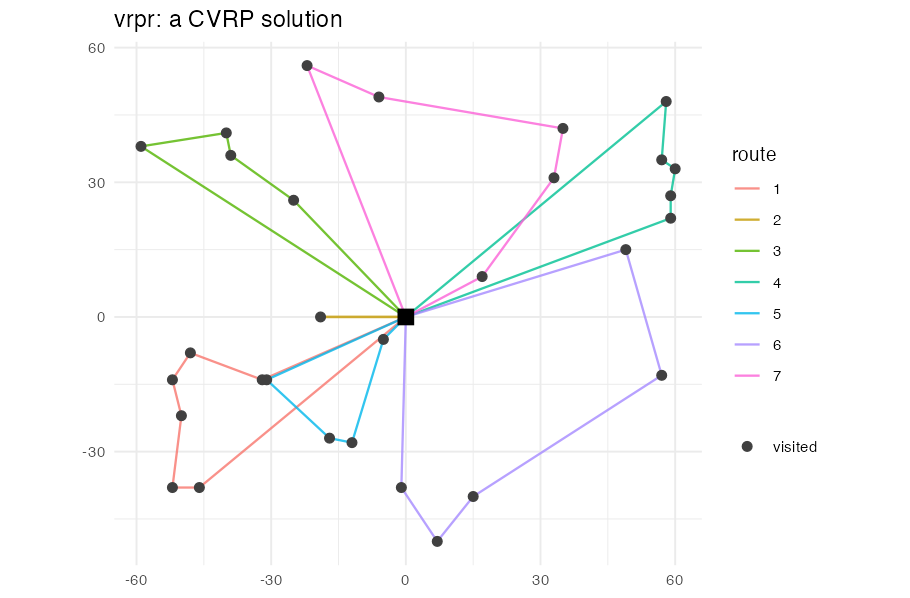
plot(res)      # the routes, with {ggplot2}
Variants
| Variant | How |
|---|---|
| Time windows (VRPTW) | add tw_early, tw_late, service to clients |
| Heterogeneous fleet | call add_vehicle_type() several times with different capacities/costs |
| Multiple depots (MDVRP) | several add_depot() + add_vehicle_type(depot = i) |
| Prize-collecting | required = FALSE + prize on clients; add_client_group() for exclusive sets |
| Pickup & delivery / backhaul | add a pickup column to clients |
| Paired pickup-and-delivery (PDP) | add_shipments() with pickup/delivery points |
| Multi-trip | add_vehicle_type(reload_depots = i, max_reloads = k) |
See the Getting started guide and the Articles for worked examples of each.
Reading standard instances
m <- read_vrplib(system.file("extdata", "sample-n6-k2.vrp", package = "vrpr"))
m <- read_solomon(system.file("extdata", "sample-solomon.txt", package = "vrpr"))
res <- m |> vrp_solve(stop = max_runtime(5))
How it works

vrpr is a thin, idiomatic R skin over PyVRP's C++ engine:
- Tidy R API — you build a model from tibbles and call
vrp_solve(). - R orchestration — the iterated local search loop, penalty manager and stopping criteria, a
faithful port of PyVRP's
IteratedLocalSearch. - cpp11 binding — long-lived C++ objects travel as external pointers; data crosses as tibbles and matrices, with integer-measure validation at the boundary.
- Vendored PyVRP C++ core (
src/vendor/pyvrp/, version pinned intools/PYVRP_VERSION) — the hot compute: problem data, cost evaluation, solutions and the local-search operators.
The light R loop drives the heavy C++ search, so you get PyVRP-grade performance with a pure-R, Python-free workflow.
License
MIT. Derived from PyVRP (© PyVRP contributors, Thibaut Vidal, ORTEC), whose copyright is preserved;
see inst/COPYRIGHTS.