DAGassist
Align Regressions with Target Estimands
Provides tools to align estimands with the identification
that they require. Given a 'dagitty' object and a model specification,
'DAGassist' classifies variables by causal roles, recovers a target estimand,
and generates a report comparing the original model with DAG-derived
adjustment sets. Supports exporting publication-grade reports in 'LaTeX', 'Word', 'Excel',
'dotwhisker', or plain text/'markdown'. 'DAGassist' is built on 'dagitty', an
'R' package that uses the 'DAGitty' web tool (< https://dagitty.net/>) for
creating and analyzing DAGs. Methods draw on Pearl (2009)
DAGassist: Align Regressions with Target Estimands 


Adding a control variable can change what a regression estimates, not just how precisely it estimates it. Controlling for mediators can shift the estimand, while controlling for colliders or their descendants can introduce bias. DAGassist uses your causal diagram (DAG) and existing regression to classify variables by their causal role, flag potentially inappropriate controls, and automatically reestimate the model using DAG-derived adjustment sets. It can also estimate explicitly specified causal effects and generate publication-grade diagnostic reports.
Installation
You can install DAGassist with:
install.packages("DAGassist")
You can also install the development version using devtools:
# install.packages("devtools")
devtools::install_github("grahamgoff/DAGassist")
Example
Does higher income increase voter turnout? DAGassist includes a
simulated dataset, turnout_data, and its corresponding causal diagram,
turnout-dag. Because the data-generating process is known, we know
that income’s total effect is 0.50, of which 0.30 is direct and
0.20 operates through political interest.
#load example data
data("turnout_data")
data("turnout_dag")

A common approach is to control for every available predictor of the
outcome. However, whether a control is appropriate depends on its causal
role. DAGassist uses the DAG to identify these roles and automatically
reestimates models using valid adjustment sets. To get started, simply
provide your DAG and original regression call:
DAGassist(turnout_dag,
          lm(turnout ~ income + parental_ses + age + polint + industry + elect_comp,
             data = turnout_data),
          show = "roles", type = "text", verbose = FALSE)
| Variable | Role | Exp. | Out. | CON |
MED |
dConfOn | NCT |
NCO |
|---|---|---|---|---|---|---|---|---|
| age | confounder | x | ||||||
| elect_comp | nco | x | ||||||
| income | exposure | x | ||||||
| industry | nct | x | x | |||||
| parental_ses | confounder | x | ||||||
| polint | mediator | x | ||||||
| turnout | outcome | x |
DAGassist identifies polint as a mediator (i.e., it is one of the
mechanisms through which income affects turnout). Controlling for it
therefore shifts the estimand away from the total effect. In this
simulation, the resulting coefficient approximates the direct effect.
The causal roles
guide
explains each classification in greater detail.
DAGassist(turnout_dag,
          lm(turnout ~ income + parental_ses + age + polint + industry + elect_comp,
             data = turnout_data),
          show = "models", type = "text", verbose = FALSE)
| Term | Original | Minimal 1 | Canonical |
|---|---|---|---|
| income | 0.281*** | 0.493*** | 0.492*** |
| (0.016) | (0.016) | (0.015) | |
| parental_ses | 0.331*** | 0.324*** | 0.332*** |
| (0.017) | (0.019) | (0.018) | |
| age | 0.275*** | 0.273*** | 0.267*** |
| (0.017) | (0.020) | (0.019) | |
| polint | 0.420*** | ||
| (0.014) | |||
| industry | -0.017 | -0.010 | |
| (0.015) | (0.016) | ||
| elect_comp | 0.500*** | 0.506*** | |
| (0.014) | (0.015) | ||
| Num.Obs. | 5000 | 5000 | 5000 |
| R2 | 0.596 | 0.423 | 0.525 |
- p-value legend: + < 0.1, * < 0.05, ** < 0.01, *** < 0.001.
- Controls (minimal): {age, parental_ses}.
- Controls (canonical): {age, elect_comp, industry, parental_ses}.
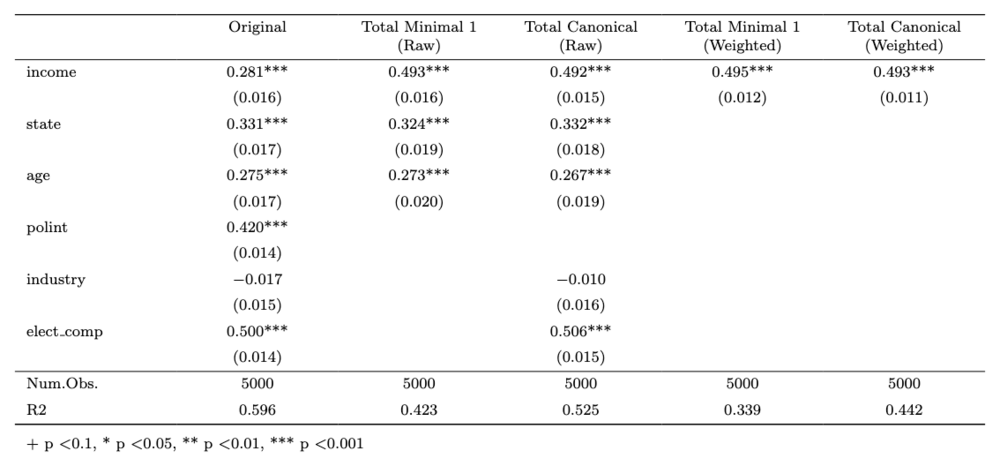
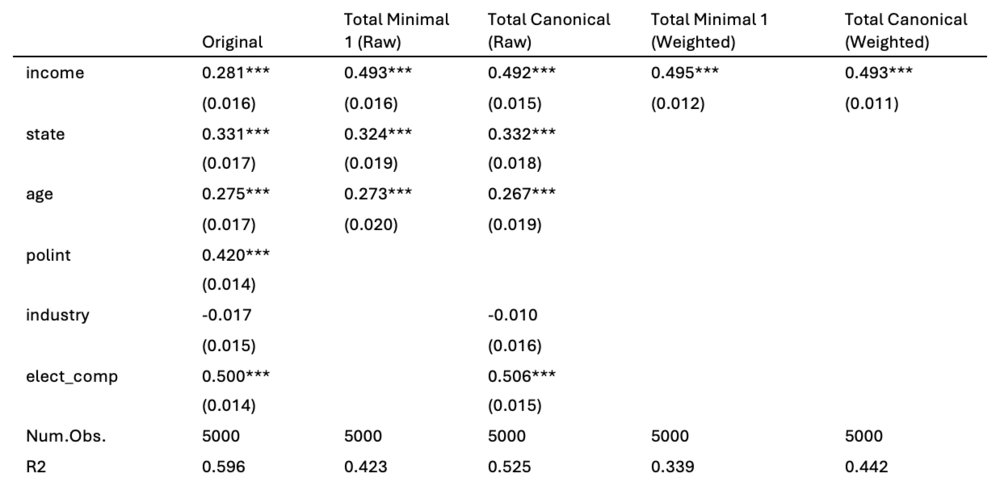
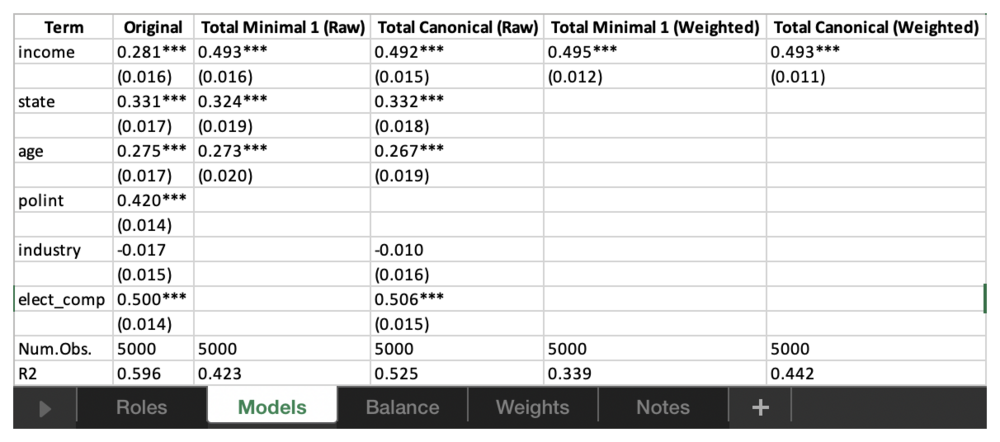
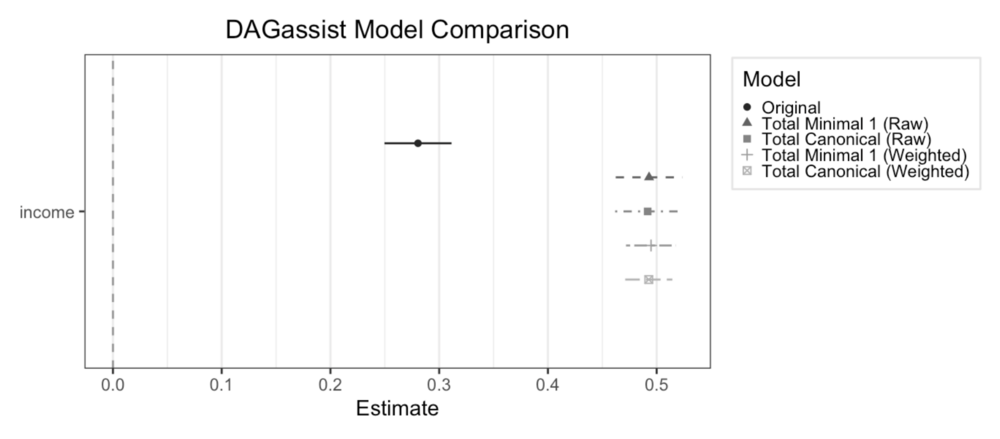
The original regression estimates an effect of approximately 0.28, close
to the true direct effect of 0.30. By excluding the mediator, both
DAG-derived specifications produce estimates of approximately 0.49,
close to the true total effect of 0.50. Without DAGassist, a
researcher might mistakenly interpret the original coefficient as a
total effect. DAGassist identifies the estimand-shifting control and
automatically reestimates the model using appropriate adjustment sets.

What else DAGassist does
- Target an estimand explicitly.
estimand = "total"estimates sample-average total effects using inverse-probability weighting;"direct"uses sequential g-estimation, including weighted direct-effect estimates. - Stress-test the DAG.
pdag_robustness()evaluates uncertain arrow directions;add_edges_robustness()checks potentially omitted causal relationships. - Check whether the data support the estimates. Diagnostics assess sample-composition changes, effective sample sizes, and weighting problems.
- Work with existing regression models. DAGassist supports
lm,glm,fixest,lme4,estimatr, and other common regression engines (supported models). - Export publication-ready reports. Set
typeto"latex","word","excel","text", or"dotwhisker"to generate formatted reports and figures.
|
|
|
|
|
|
Citation
citation("DAGassist")
#> To cite package 'DAGassist' in publications use:
#>
#>   Goff G, Denly M (2026). _DAGassist: Align Regressions with Target
#>   Estimands_. R package version 0.3.1,
#>   <https://grahamgoff.com/DAGassist/>.
#>
#> A BibTeX entry for LaTeX users is
#>
#>   @Manual{,
#>     title = {{DAGassist}: Align Regressions with Target Estimands},
#>     author = {Graham Goff and Michael Denly},
#>     year = {2026},
#>     note = {R package version 0.3.1},
#>     url = {https://grahamgoff.com/DAGassist/},
#>   }