metacoder
Tools for Parsing, Manipulating, and Graphing Taxonomic Abundance Data
Reads, plots, and manipulates large
taxonomic data sets, like those generated from modern high-throughput
sequencing, such as metabarcoding (i.e. amplification metagenomics, 16S
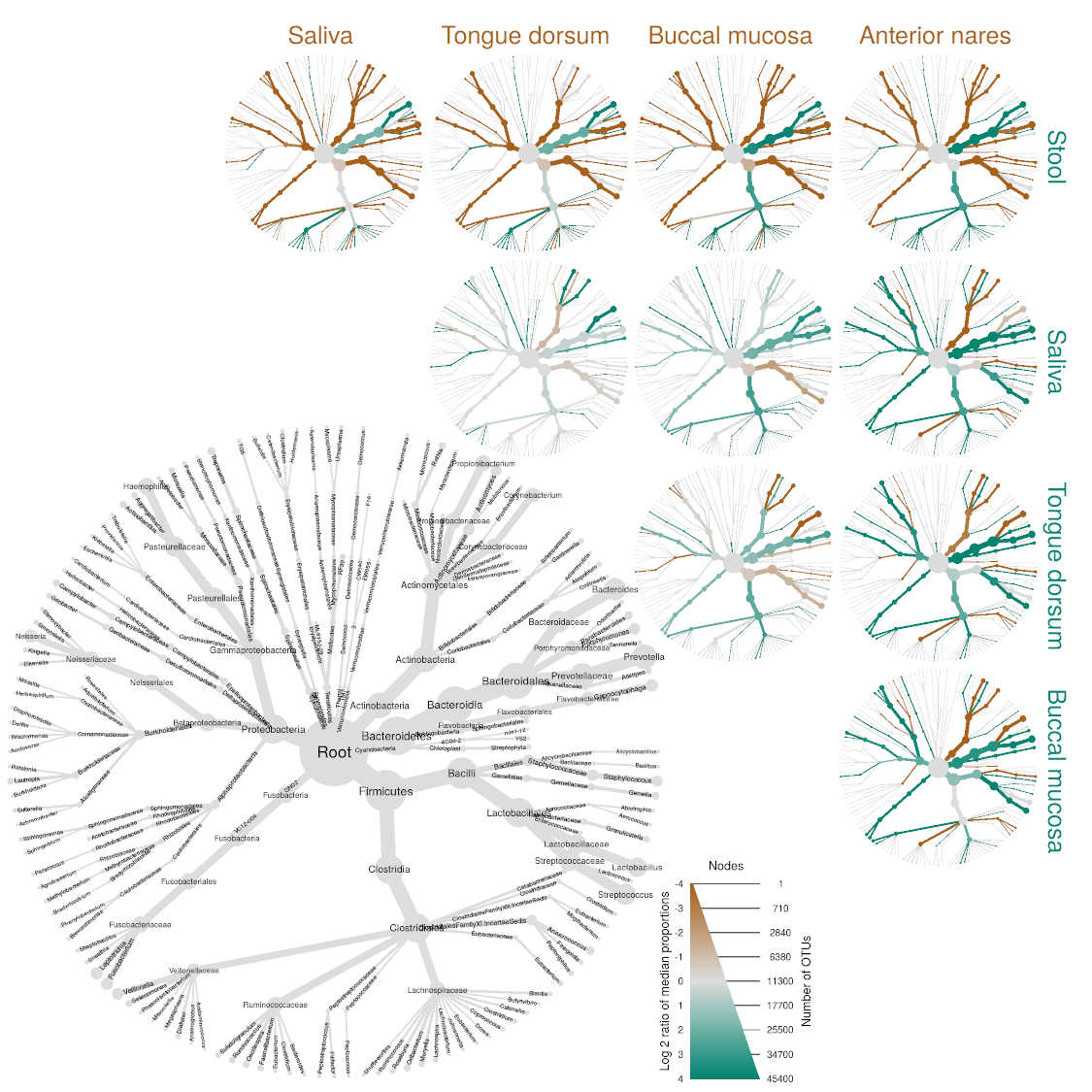
metagenomics, etc). It provides a tree-based visualization called "heat
trees" used to depict statistics for every taxon in a taxonomy using
color and size. It also provides various functions to do common tasks in
microbiome bioinformatics on data in the 'taxmap' format defined by the
'taxa' package. The 'metacoder' package is described in the publication
by Foster et al. (2017)
An R package for metabarcoding research planning and analysis
Metacoder is an R package for reading, plotting, and manipulating large
taxonomic data sets, like those generated from modern high-throughput
sequencing, like metabarcoding (i.e. amplification metagenomics, 16S
metagenomics, etc). It provides a tree-based visualization called “heat
trees” used to depict statistics for every taxon in a taxonomy using
color and size. It also provides various functions to do common tasks in
microbiome bioinformatics on data in the taxmap format defined by the
taxa package, such as:
- Summing read counts/abundance per taxon
- Converting counts to proportions and rarefaction of counts using
vegan - Comparing the abundance (or other characteristics) of groups of samples (e.g., experimental treatments) per taxon
- Combining data for groups of samples
- Simulated PCR, via EMBOSS primersearch, for testing primer specificity and coverage of taxonomic groups
- Converting common microbiome formats for data and reference databases
into the objects defined by the
taxapackage. - Converting to and from the
phyloseqformat and thetaxaformat
Installation
This project is available on CRAN and can be installed like so:
install.packages("metacoder")
You can also install the development version for the newest features, bugs, and bug fixes:
install.packages("devtools")
devtools::install_github("grunwaldlab/metacoder")
Documentation
All the documentation for metacoder can be found on our website here:
https://grunwaldlab.github.io/metacoder_documentation/
Dependencies
The function that simulates PCR requires primersearch from the EMBOSS
tool kit to be installed. This is not an R package, so it is not
automatically installed. Type ?primersearch after installing and
loading metacoder for installation instructions.
Relationship with other packages
Many of these operations can be done using other packages like
phyloseq, which also provides tools for diversity analysis. The main
strength of metacoder is that its functions use the flexible data
types defined by taxa, which has powerful parsing and subsetting
abilities that take into account the hierarchical relationship between
taxa and user-defined data. In general, metacoder and taxa are more
of an abstracted tool kit, whereas phyloseq has more specialized
functions for community diversity data, but they both can do similar
things. I encourage you to try both to see which fits your needs and
style best. You can also combine the two in a single analysis by
converting between the two data types when needed.
Citation
If you use metcoder in a publication, please cite our article in PLOS Computational Biology:
Foster ZSL, Sharpton TJ, Grünwald NJ (2017) Metacoder: An R package for visualization and manipulation of community taxonomic diversity data. PLOS Computational Biology 13(2): e1005404. https://doi.org/10.1371/journal.pcbi.1005404
Future development
Metacoder is under active development and many new features are planned. Some improvements that are being explored include:
- Barcoding gap analysis and associated plotting functions
- A function to aid in retrieving appropriate sequence data from NCBI for in silico PCR from whole genome sequences
- Graphing of different node shapes in heat trees, possibly including pie graphs or PhyloPics.
- Adding the ability to plot specific edge lengths in the heat trees so they can be used for phylogenetic trees.
- Adding more data import and export functions to make parsing and writing common formats easier.
To see the details of what is being worked on, check out the issues tab of the Metacoder Github site.
License
This work is subject to the MIT License.
Acknowledgements
Metacoder’s major dependencies are taxa, taxize, vegan, igraph,
dplyr, and ggplot2.
This package includes code from the R package
ggrepel to handle label overlap
avoidance with permission from the author of
ggrepel Kamil
Slowikowski. We included the code instead
of depending on ggrepel because we are using functions internal to
ggrepel that might change in the future. We thank Kamil Slowikowski
for letting us use his code and would like to acknowledge his
implementation of the label overlap avoidance used in metacoder.
Feedback and contributions
We would like to hear about users’ thoughts on the package and any errors they run into. Please report errors, questions or suggestions on the issues tab of the Metacoder Github site. We also welcome contributions via a Github pull request. You can also talk with us using our Google groups site.